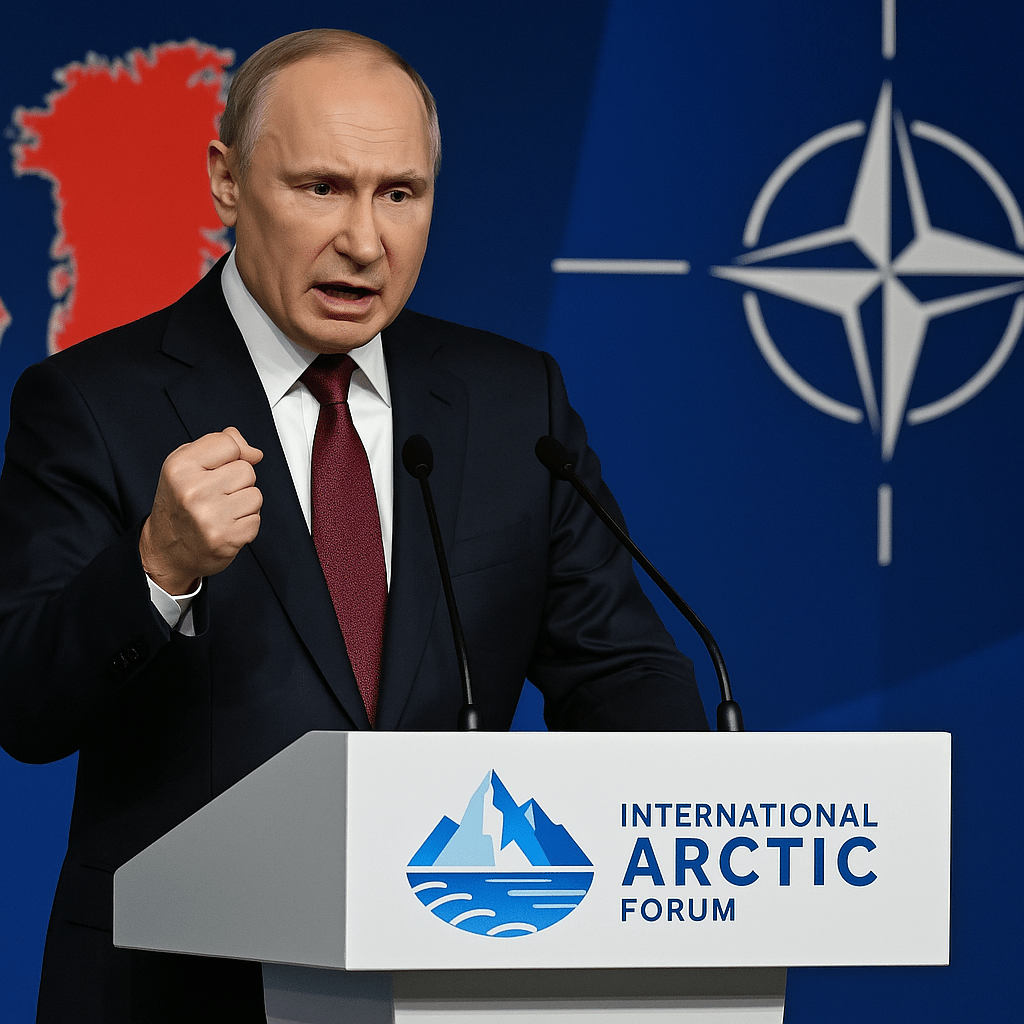
On March 27, 2025, the icy expanse of the Arctic turned into a new theatre of geopolitical friction as Russian President Vladimir Putin, speaking at the International Arctic Forum in Murmansk, issued a stern warning about growing international competition in the region. Putin’s message was twofold: a signal of military vigilance against the West and a call for economic cooperation despite rising tensions.
The Arctic’s Strategic Emergence
Once viewed as an isolated frozen frontier, the Arctic is fast becoming a hotspot of global competition. As climate change accelerates the melting of polar ice, the region is unlocking previously inaccessible natural resources—oil, gas, and rare minerals—and strategic shipping lanes, particularly the Northern Sea Route (NSR). This transformation has drawn in Arctic nations like Russia, the US, Canada, Denmark, and newcomers to the conversation like China, which calls itself a “near-Arctic” power.
Putin’s remarks at the forum outlined Russia’s mounting concerns over Western encroachment, particularly highlighting US interest in Greenland and NATO’s enhanced military posture, especially with Finland and Sweden joining the alliance. According to Putin, NATO is “designating the far north as a springboard for possible conflicts,” prompting Russia to boost its troop presence to protect its Arctic interests.
US Moves and Greenland’s Geopolitical Weight
Much of Putin’s frustration stems from renewed US ambitions in Greenland, amplified by President Donald Trump’s persistent interest in acquiring the island. During a recent address, Trump reasserted, “We need Greenland, and the world needs us to have Greenland.” His administration sees the island’s strategic location and the Pituffik Space Base—critical for missile detection—as vital assets.
The situation further escalated during US Vice President JD Vance’s late-March visit to Greenland, where he accused Denmark of underinvesting in the island’s security, prompting backlash from Greenlandic and Danish leaders. Greenland’s Prime Minister Mute Egede criticized the visit as “interference” and a “lack of respect for our self-determination.”
Russia’s Arctic Playbook: Militarization Meets Market Diplomacy
Despite strong rhetoric, Putin balanced his warning with calls for economic cooperation. He emphasized that Russia is open to joint ventures in Arctic development, particularly in container transport, bulk cargo, and port infrastructure. Countries like Belarus, China, and the UAE have already shown interest in the expansion of Murmansk Port and Russia’s flagship Yamal LNG project.
Russia’s dual approach—military assertion coupled with economic engagement— highlights a calculated strategy. While boosting nuclear-powered icebreaker fleets and conducting large-scale military exercises, Moscow is also seeking foreign investment to develop Arctic infrastructure and logistics, especially along the Northern Sea Route, which saw a 25% rise in oil shipments to China last year.
The NATO Angle: Security and Strategy
On the other side, NATO’s increased Arctic engagement reflects growing concerns about Russia’s rapid militarization and China’s creeping presence in the region. Since Russia’s 2022 invasion of Ukraine, NATO has reoriented its security outlook, with Arctic members like Norway, Sweden, and Finland reassessing their defense postures.
Defense analysts warn of an emerging security dilemma: while Russia views its actions as protective, NATO countries interpret them as aggressive, prompting their own buildups. This tit-for-tat dynamic evokes a Cold War-like atmosphere, raising the risk of miscalculation in a region once known for scientific cooperation and low tensions.
International Law, the Arctic Council, and the Erosion of Governance
One major casualty of the geopolitical strain has been the Arctic Council, the main forum for intergovernmental cooperation in the region. Russia’s suspension from the Council following the Ukraine invasion has paralyzed key areas of collaboration, including climate research, indigenous rights, and ecological protection.
Disputes over maritime boundaries, resource claims, and interpretations of international law, particularly UNCLOS, further complicate the picture. The US’s non-ratification of UNCLOS limits its legal leverage, while Russia and Canada assert overlapping claims. These legal uncertainties, coupled with rising militarization, challenge efforts to maintain Arctic governance frameworks.
Conclusion: Frozen Frontiers, Heated Rivalries
President Putin’s speech was more than a nationalistic assertion; it was a reflection of the Arctic’s evolution into a high-stakes geopolitical frontier. The race is no longer just about ice and isolation—it’s about energy security, strategic dominance, and future shipping routes. Russia’s simultaneous projection of power and partnership is emblematic of a broader strategic calculus: deterring adversaries while attracting allies to co-develop the Arctic.
As attention shifts towards the north, the Arctic finds itself at a pivotal juncture. How major powers navigate this icy chessboard, balancing national interests with shared responsibilities in one of the planet’s most fragile and valuable ecosystems, will determine whether the Arctic becomes a zone of cooperation or confrontation.
 GeoWire
Leave a comment