
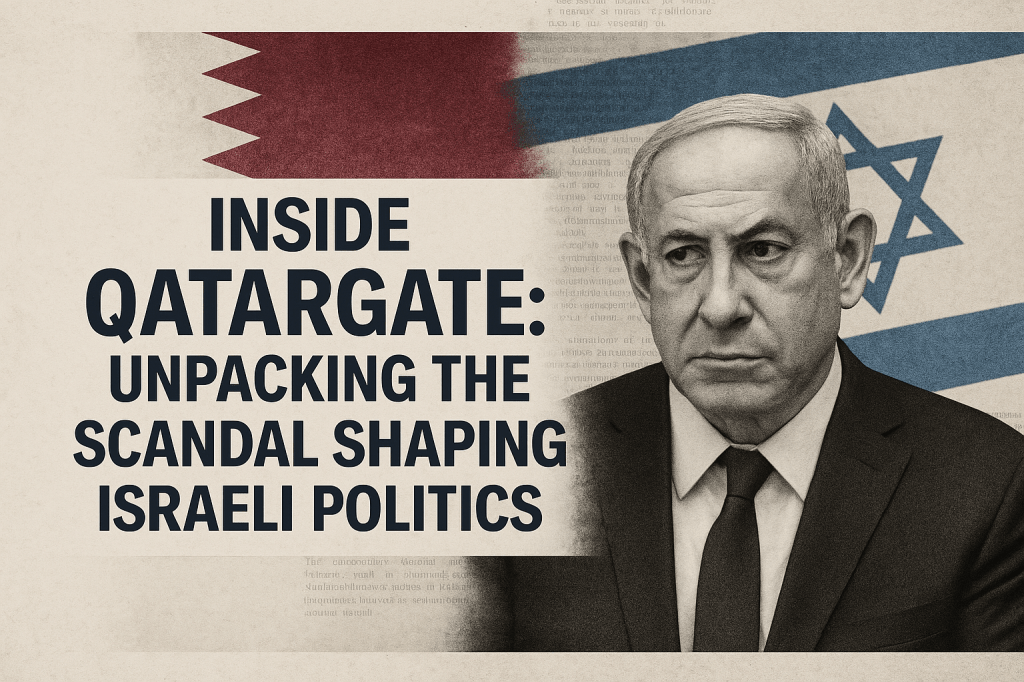
In the turbulent landscape of Israeli politics, few scandals have hit closer to the heart of governance and public trust than the unfolding “Qatargate” controversy. As revelations emerge implicating Prime Minister Benjamin Netanyahu’s top aides in covert dealings with Qatar—an adversarial regional actor—Israel finds itself at a critical juncture where national security, foreign policy, and political integrity converge in a storm of allegations, arrests, and public outcry.
The Origins of the Scandal: Foreign Influence Meets Domestic Fragility
Qatargate surfaced in mid-2024 through Israeli media reports, later confirmed by law enforcement investigations. The core allegation is that two of Netanyahu’s longtime aides—Jonatan Urich and Eli Feldstein—accepted payments from the Gulf state of Qatar to influence public discourse in Israel. The goal? Promote Qatar’s image as a benevolent mediator in the Israeli-Hamas conflict and discredit Egypt’s parallel efforts.
What makes this arrangement particularly controversial is Qatar’s ambiguous role in the region. Despite having no formal diplomatic ties with Israel, Qatar plays a central role in Gaza through financial aid, political mediation, and—more controversially—hosting Hamas leaders. For many Israelis, this is a bitter contradiction: while Qatar negotiates hostage deals, its financial assistance to Hamas has allegedly funded the October 7, 2023, attacks on Israeli soil.
The Allegations: Cash, Classified Documents, and PR Spin
The investigation by Israel’s Shin Bet and national police uncovered a trail of payments linked to Jay Footlik, a U.S. lobbyist working for Qatar through his firm, Third Circle Inc. Feldstein and Urich allegedly worked through this firm to push pro-Qatar narratives, arrange journalist visits to Doha, and issue public statements under the guise of “senior Israeli officials.” Some statements, critics claim, may have been framed as if emanating from the Prime Minister himself.
Financial irregularities abound. Payments were routed through Israeli businessman Gil Birger for suspicious VAT-related reasons, raising money laundering red flags. Urich is also suspected of leaking classified information to Footlik, while Feldstein faces separate charges for sharing documents with the German newspaper Bild. The spectrum of legal charges spans from breach of trust and money laundering to potential espionage and bribery.
Though Netanyahu was questioned, he remains officially untarnished—at least for now. He dismisses the scandal as a “political witch hunt,” echoing refrains familiar from his ongoing corruption trial and numerous battles with Israel’s judiciary.
The Political Earthquake: Netanyahu Under Siege
The scandal couldn’t have emerged at a more politically vulnerable moment. Israel is still grappling with the aftermath of the October 7 attacks, the ongoing war in Gaza, and a deeply polarised public. The attempt by Netanyahu to dismiss Shin Bet chief Ronen Bar—overseeing the Qatargate probe—was swiftly blocked by the Supreme Court, signalling a constitutional face-off between the executive and judicial branches.
Public sentiment is shifting rapidly. A recent poll reveals that 70% of Israelis want Netanyahu to resign, either now or after the Gaza conflict ends. Tens of thousands have taken to the streets, voicing disillusionment not just with the scandal but with Netanyahu’s broader leadership—his judicial reforms, his handling of war strategy, and now, his proximity to foreign money.
Expert Commentary: Democracy on Trial
Columnists and regional analysts are scathing in their assessments. Ravit Hecht of Haaretz calls Qatargate “a serious blow to Netanyahu’s soft underbelly,” noting that the scandal could permanently fracture his support base. Pakistani scholar Husain Haqqani bluntly stated that the affair may have prolonged the war in Gaza by undermining Egyptian mediation—suggesting lives were lost in the process of political manoeuvring.
Journalist Matti Friedman perhaps put it best: “Qatari money is like fingerprints that appear when an ultraviolet light turns on. But few suspected the light would reveal fingerprints inside Israel itself.”
A Scandal with Regional and Strategic Ripples
Qatargate’s implications go far beyond Israel’s borders. If proven true, the scandal reveals how Middle Eastern states are competing not just on military or diplomatic fronts, but also through information warfare, lobbying, and influence campaigns. For a country like Israel—long vigilant about foreign interference—this internal breach by a supposed adversary is deeply unsettling.
Moreover, Netanyahu’s international standing has already been weakened. He faces an International Criminal Court investigation for alleged war crimes in Gaza. His perceived willingness to shield loyalists over institutional integrity is fuelling concerns in foreign capitals about the durability of Israeli democracy under his leadership.
Conclusion: Crossroads for a Nation
Qatargate is not merely a corruption scandal; it is a test of Israel’s democratic resilience and moral compass. As the legal process unfolds and public pressure mounts, the outcome may define not just Netanyahu’s legacy, but the future architecture of Israeli governance and its diplomatic posture in a volatile region.
Will this scandal prompt a reckoning within the Israeli political establishment, or will it be yet another chapter in the saga of political survival?
 GeoWire
Leave a comment