
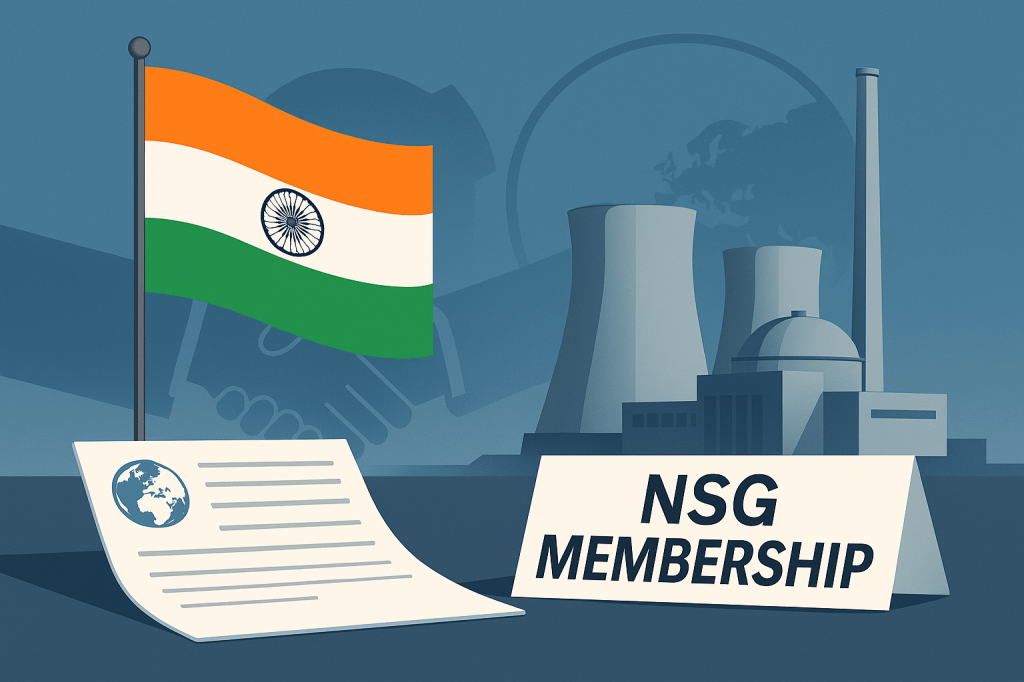
India’s pursuit of membership in the Nuclear Suppliers Group (NSG) has generated extensive debate, primarily due to its status as a non-signatory to the Nuclear Non-Proliferation Treaty (NPT). Nonetheless, India’s strong record of responsible nuclear stewardship, reinforced by its rigorous adherence to global nuclear norms, presents a compelling case for NSG membership.
Historical Background and Context
The NSG, formed in 1974 in response to India’s first nuclear test (“Smiling Buddha”), currently comprises 48 countries focused on curbing nuclear proliferation through stringent export controls. Despite being a non-signatory to the NPT, India formally applied for NSG membership in May 2016. The primary opposition to India’s entry comes from China, emphasizing NPT membership as a prerequisite. However, India’s 2008 NSG waiver allowing civil nuclear trade underscores a tacit recognition of India’s responsible nuclear conduct by the international community. Additionally, India’s inclusion in other major export control groups—the Missile Technology Control Regime (MTCR, 2016), Wassenaar Arrangement (2017), and Australia Group (2018)—further strengthens its NSG candidacy.
India’s Non-Proliferation Credentials
India’s non-proliferation record stands as a testament to its responsible nuclear behavior, characterized by several definitive actions and policies:
- No-First-Use Policy: India’s 2003 nuclear doctrine explicitly declares a no-first-use stance, ensuring nuclear weapons would only be utilized in retaliation, emphasizing deterrence rather than aggression.
- Testing Moratorium: Following its 1998 nuclear tests (Pokhran-II), India voluntarily announced and has diligently maintained a moratorium on nuclear testing for over 26 years, demonstrating a clear commitment to global stability.
- Robust Export Controls: The enactment of the Weapons of Mass Destruction and their Delivery Systems Act (2005) aligns India’s legislation with international standards set by UNSC Resolution 1540, effectively prohibiting proliferation-sensitive transactions.
- IAEA Safeguards: India places its civilian nuclear facilities under comprehensive safeguards by the International Atomic Energy Agency (IAEA), ensuring transparency and adherence to peaceful nuclear usage.
Collectively, these measures illustrate India’s unwavering dedication to the fundamental principles of nuclear non-proliferation, even without formal NPT membership.
Benefits of NSG Membership
India’s inclusion in the NSG promises considerable advantages, both domestically and globally:
For India:
- Access to Advanced Technology: NSG membership would grant India smoother access to cutting-edge nuclear technologies critical for energy security and achieving its ambitious climate commitments, including sourcing 40% of its power from clean, non-fossil-fuel-based sources by 2030.
- Influence on Global Norms: India would gain a meaningful voice in setting international nuclear trade standards, thus aligning global practices with India’s strategic and economic interests.
- Economic Opportunities: Enhanced opportunities for India’s nuclear industry to export technologies and services, potentially spurring economic growth under initiatives like “Make in India.”
For the International Community:
- Strengthening Non-Proliferation Efforts: Incorporating India—a major nuclear-capable state with exemplary non-proliferation credentials—would bolster NSG effectiveness in managing global nuclear trade and curtailing proliferation risks, especially in South Asia.
- Climate Action Support: India’s increased nuclear energy capacity, facilitated by NSG membership, would significantly contribute to global efforts in reducing carbon emissions, aligning with international climate objectives.
- Enhanced Multilateral Cooperation: India’s membership would ensure broader representation within the NSG, reflecting the contemporary geopolitical landscape and enhancing the group’s global legitimacy.
Addressing Major Counterarguments
Opposition to India’s NSG membership primarily centers on its non-NPT status and geopolitical considerations:
- Non-NPT Membership Concern: Critics argue India’s admission could weaken the NPT regime. However, the NSG operates independently from the NPT, demonstrated by the 2008 waiver. India’s stringent export controls and proactive measures exceed obligations of some existing NPT signatories, reinforcing rather than undermining global non-proliferation norms.
- Geopolitical Opposition: China’s objections, largely rooted in geopolitical rivalry and advocacy for Pakistan’s parallel inclusion, contrast starkly with India’s demonstrably superior non-proliferation record. The international community broadly acknowledges India’s responsible nuclear stewardship, evidenced by consistent support from the U.S., France, and other influential NSG members.
Recent International Support and Comparative Analysis
In March 2025, Rafael Mariano Grossi, Director General of the IAEA, emphasized the logical inconsistency of excluding India from the NSG, given its established membership in three other major export control regimes. This international endorsement further legitimizes India’s claim.
A comparative examination of membership criteria across major export control regimes illustrates clearly that the NSG’s preference for NPT signatories is flexible rather than mandatory, as evidenced by India’s participation in MTCR, Wassenaar Arrangement, and Australia Group.
Conclusion
India’s bid for NSG membership is compelling and justified, anchored in its exemplary nuclear record, comprehensive non-proliferation commitments, and the clear benefits its membership would deliver domestically and internationally. The NSG’s legitimacy and effectiveness depend on recognizing evolving geopolitical realities. Therefore, acknowledging India’s responsible nuclear conduct by admitting it into the NSG would fortify the global non-proliferation architecture, foster international stability, and enhance multilateral cooperation.
 GeoWire
Leave a comment