
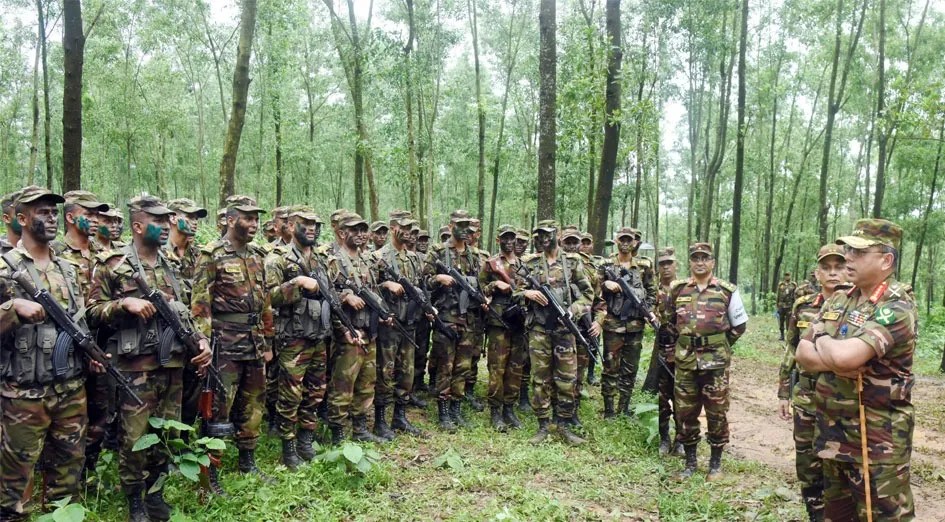
The political landscape in Bangladesh has grown increasingly volatile following the ousting of former Prime Minister Sheikh Hasina in August 2024. Her removal, prompted by mass student-led protests against a controversial job quota system, led to the formation of an interim government under Nobel Laureate Dr. Muhammad Yunus. In recent weeks, however, the Bangladesh Army’s visible presence in Dhaka has fueled speculations of a possible coup—raising concerns rooted in the country’s long history of military interventions.
Current Situation (As of March 23, 2025)
Recent developments have centered on military deployments, Islamic protests, and social media disinformation campaigns, leading to a tense atmosphere in the capital.
On March 22, 2025, the Bangladesh Army, specifically the 9th Infantry Division from Savar, mobilized armored vehicles and personnel to key areas in Dhaka, including Rampura, Shantinagar, Kakrail, Baitul Mukarram Mosque, Mohakhali, Gulshan, Khilkhet, and Bijoy Sarani. These movements coincided with protests by Islamic groups near Baitul Mukarram, condemning Israeli military actions in Gaza and anti-Muslim violence in India.
Checkpoints were set up throughout the city, and joint forces, including army, police, and Border Guard Bangladesh (BGB), conducted searches around mosques and intersections. The Inter-Services Public Relations Directorate (ISPR) clarified that these were routine law enforcement measures aimed at intercepting suspicious vehicles and individuals, not political in nature.
Disinformation and Social Media Campaigns
Complicating the situation is a social media campaign by activist Pinaki Bhattacharya, targeting Chief of Army Staff (CAS) General Waker-Uz-Zaman, accusing him of being pro-India and calling for extremist mobilization. These digital provocations have fueled further unrest, prompting the army to maintain heightened vigilance.
Official Denials and Responses
The Bangladesh Army and government have strongly denied all allegations of a coup attempt. In early March, rumors circulated that Lt. Gen. Faizur Rahman, Quartermaster General and a known Jamaat-e-Islami sympathizer, had been building support among military commanders to unseat the current CAS. However, these claims were firmly rejected by both Bangladeshi officials and Indian intelligence, who labeled them “malicious,” “baseless,” and “grossly wrong.”
In response, on March 13, 2025, the Ministry of Defence of Bangladesh issued a statement titled “Response to False Reports on Bangladesh Army by Certain Media Outlets From India”, calling out a coordinated disinformation campaign meant to destabilize the interim administration.
Further speculation arose when student leader Hasnat Abdullah accused the CAS of suggesting a political rehabilitation of the Awami League during a March 11 meeting. The army responded by calling the claims “highly laughable and immature,” clarifying that the CAS merely expressed personal reflections on democratic transitions, not political directives.
Historical Context: Coups and Civil-Military Relations
Bangladesh has experienced 29 coup attempts since 1975, some successful, leaving a long-standing mistrust between civil and military institutions. The August 2024 political upheaval, which installed Muhammad Yunus as interim Chief Adviser, marked the beginning of a delicate transition period—one which remains vulnerable to public unrest, student mobilization, and geopolitical pressures, particularly regarding India’s perceived influence and sectarian tensions.
In this fragile context, the army has been formally empowered under executive magistracy provisions (granted since September 2024 and extended to May 2025) to enforce law and order. This makes military presence in civilian spaces legal, but politically sensitive.
Interim Government and Reform Goals
Dr. Yunus continues to push forward with governance and electoral reforms, aiming for national elections between December 2025 and March 2026. On March 21, 2025, he received a report from the Media Reform Commission, signaling active institutional development. However, persistent unrest, especially from student groups and religious factions, complicates this transition.
Internationally, Yunus enjoys cautious support:
- On December 23, 2024, U.S. National Security Advisor Jake Sullivan reaffirmed Washington’s commitment to Bangladesh’s democratic transition.
- On March 16, 2025, the UN Secretary-General acknowledged the transitional government’s progress and offered peacebuilding support.
Student-Military Frictions
Tensions remain high between the military and student leaders who played a central role in Sheikh Hasina’s ouster. Military mobilization on March 22, paired with Hasnat Abdullah’s claims and continued social media activity, has deepened the mistrust. While the army insists that its actions are solely precautionary and professional, public perception of politicization persists.
Comparative Timeline of Key Events
| Event | Date | Details | Impact |
|---|---|---|---|
| Army Deployments | March 22, 2025 | 9th Infantry Division mobilized across Dhaka | Raised speculation; official clarification by ISPR |
| Islamic Protests | March 22, 2025 | Anti-Israel and anti-India protests near Baitul Mukarram | Prompted security operations and checkpoint enforcements |
| Coup Rumors | Early March 2025 | Alleged plot by Lt. Gen. Faizur Rahman | Denied by government and Indian intel as misinformation |
| Student-Military Meeting | March 11, 2025 | CAS met with student leaders; allegations of political interference | Army dismissed claims; reinforced commitment to neutrality |
| Yunus’s Governance Plans | March 6–21, 2025 | Received media reform report; affirmed elections timeline | Governance intact; security challenges remain |
Conclusion: A Fragile State or Rising Threat?
As of March 23, 2025, the Bangladesh Army’s operations appear to be focused on internal security amid protests and growing political tensions—not preparations for a coup against the interim government led by Muhammad Yunus. Despite historic patterns of military interventions, the current evidence points to a state attempting to stabilize, not subvert, democratic transition. However, the broader context raises critical questions about Bangladesh’s political trajectory and the influence of Islamist actors in the post-Hasina era.
A notable warning comes from Michael Rubin, a senior fellow at the American Enterprise Institute, who, in a March 18, 2025, Washington Examiner article, argues that Bangladesh is “quickly transforming into a terrorist safe haven”, drawing comparisons to Afghanistan in the early 2000s. Rubin claims that under the cover of Yunus’s interim administration, radical Islamist groups such as Jamaat-e-Islami, Harakat-ul-Jihad-al-Islami-Bangladesh, and Neo-Jamaat-ul-Mujahideen Bangladesh are consolidating control, launching attacks on minorities, and deepening links with international terror networks like Lashkar-e-Taiba and the Islamic State.
Rubin further alleges that freed militants from Hizb-ut-Tahrir and Khelafat-e-Majlis, along with coalitions such as Heefazat-e-Islam, are actively pushing for the Islamization of the Bangladeshi state. The slogan “Bangladesh will become Afghanistan, and we will become Taliban,” reportedly raised by some radical factions, underlines growing fears of a systemic ideological shift away from secular governance.
While these claims warrant scrutiny and should be assessed within a broader geopolitical and intelligence-based framework, they serve as a warning sign for both regional and global stakeholders. Bangladesh’s urban density, maritime access, and proximity to India make it a uniquely vulnerable and potentially volatile space for the spread of extremist ideologies.
As such, it is crucial that both domestic authorities and the international community maintain a watchful eye on the interplay between political transition, military posture, and extremist infiltration in Bangladesh. What unfolds in the coming months—particularly leading up to the proposed elections between December 2025 and March 2026—may well determine whether Bangladesh stabilizes under transitional rule or slides further into ideological and geopolitical fragmentation.
 GeoWire
Leave a comment